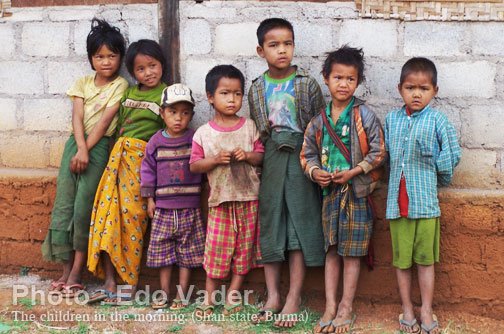
I took these photos on our mountaineer trip of the whole Myanmar universities to Sin mountain and Myin Mati mountain in
Shan state. We stilled about one week in Shan state but I saw very low education of children. It is not good for the future of our country.
Shan State (ရွမ္းျပည္နယ္
) is a state of Burma (Myanmar). Shan State borders
China to the north,
Laos to the east, and
Thailand
to the south, and five administrative divisions of Burma in the west.
Largest of the 14 administrative divisions by land area, Shan State
covers 155,800 km², almost a quarter of the total area of Burma. The
state gets its name from the Shan people, one of several ethnic groups that inhabit the area. Shan State is largely rural, with only three cities of significant size: Lashio, Kengtung, and the capital, Taunggyi.
The majority of Shan are Theravada Buddhists, and the Shan constitute one of the four main Buddhist ethnic groups in Burma; the others are the
Bamar, the
Mon and the
Rakhine.
Most Shan speak the Shan language and are bilingual in Burmese. The Shan language, spoken by about 5 or 6 million, is closely related to Thai and Lao, and is part of the family of Tai languages. The Shan are traditionally wet-rice cultivators, shopkeepers, and artisans.
Educational opportunities in Myanmar are extremely limited outside the main cities of Yangon and Mandalay.
It is especially a problem in Shan State where vast areas are beyond
government control. According to official statistics, only about 8% of
primary school students in Shan State reach high school.
| AY 2002–2003 |
Primary School |
Middle School |
High School |
| Schools |
4199 |
206 |
112 |
| Teachers |
11,400 |
3500 |
1500 |
| Students |
442,000 |
122,000 |
37,000 |