Showing posts with label snapshot. Show all posts

Monday, April 15, 2013

Thin Gyan - Myanmar New Year Water Festival

Burmese: သင်္ကြန်, Khmer: បុណ្យចូលឆ្នាំថ្មី; Lao: ສົງການ; Thai: สงกรานต์, Tamil: சொங்க்ரான், Photo : Edo Vader
Thingyan (Burmese: သင်္ကြန်; from Pali sankanta) is the Myanmar (Burmese) New Year Water Festival and usually falls around mid-April (the Burmese month of Tagu). It is a Buddhist festival celebrated over a period of four to five days culminating in the new year. Formerly the dates of the Thingyan festival are calculated according to the traditional Burmese lunisolar calendar, but now fixed to Gregorian calendar 13 to 16 April; it often coincides with Easter.

 The dates of the festival are observed as the most important public holiday throughout Burma and are part of the summer holidays at the end of the school year. Water-throwing or dousing one another from any shape or form of vessel or device that delivers water is the distinguishing feature of this festival and may be done on the first four days of the festival. However, in most parts of the country, it does not begin in earnest until the second day. Thingyan is comparable to other new year festivities in Theravada Buddhist areas of Southeast Asia such as Lao New Year, Cambodian New Year and Songkran in Thailand.

New Year Donation.
A time-honoured tradition is mont lone yeibaw (မုန့်လုံးရေပေါ်), glutinous rice balls with jaggery (palm sugar) inside thrown into boiling water in a huge wok and served as soon as they resurface which gave it the name.[1] All the young men and women help in making it and all are welcome, but watch out for some prankster putting a birdseye chilli inside instead of jaggery for a laugh! Mont let saung (မုန့်လက်ဆောင်း) is another refreshing Thingyan snack, bits of sticky rice with toasted sesame in jaggery syrup and coconut milk. They are both served with grated coconut. In major cities such as Yangon and Mandalay, Rakhine Thingyan can also be experienced as Rakhine residents of the city celebrate in their own tradition.

By nightfall, the real fun begins with music, song and dance, merrymaking and general gaiety in anticipation of the water festival. They wear fragrant thanaka - a paste of the ground bark of Murraya paniculata which acts as both sunblock and astringent - on their faces, and sweet-scented yellow padauk blossoms in their hair. The padauk (Pterocarpus macrocarpus) blooms but one day each year during Thingyan and is popularly known as the "Thingyan flower"

Monday, July 23, 2012

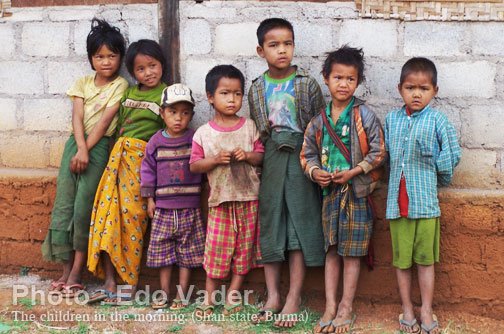
The Children of Shan State (Photo Album)

 I took these photos on our mountaineer trip of the whole Myanmar universities to Sin mountain and Myin Mati mountain in Shan state. We stilled about one week in Shan state but I saw very low education of children. It is not good for the future of our country.

 Shan State (ရွမ္းျပည္နယ္) is a state of Burma (Myanmar). Shan State borders China to the north, Laos to the east, and Thailand to the south, and five administrative divisions of Burma in the west. Largest of the 14 administrative divisions by land area, Shan State covers 155,800 km², almost a quarter of the total area of Burma. The state gets its name from the Shan people, one of several ethnic groups that inhabit the area. Shan State is largely rural, with only three cities of significant size: Lashio, Kengtung, and the capital, Taunggyi.

The majority of Shan are Theravada Buddhists, and the Shan constitute one of the four main Buddhist ethnic groups in Burma; the others are the Bamar, the Mon and the Rakhine.
Most Shan speak the Shan language and are bilingual in Burmese. The Shan language, spoken by about 5 or 6 million, is closely related to Thai and Lao, and is part of the family of Tai languages. The Shan are traditionally wet-rice cultivators, shopkeepers, and artisans.

Educational opportunities in Myanmar are extremely limited outside the main cities of Yangon and Mandalay. It is especially a problem in Shan State where vast areas are beyond government control. According to official statistics, only about 8% of primary school students in Shan State reach high school.
 
AY 2002–2003 Primary School Middle School High School
Schools 4199 206 112
Teachers 11,400 3500 1500
Students 442,000 122,000 37,000

Wednesday, February 1, 2012

Education of Burmese Children in Thailand (Photo Album)

Many people who flee persecution from Burma to Thailand are unable to enter the camps as refugees and are therefore ‘classed’ as migrants in Thailand.

There are as many as one million migrants from Burma in Thailand. With limited rights many of these migrants are employed in  D irty,  D ifficult and  D angerous low paid jobs. And what about their children?

Though under Thai law all children regardless of status should be able to access the Thai education system the reality is that due to many barriers most migrant children are unable to do so.

These barriers range from fear of the authorities, through to lacking the income to cover school costs such as uniforms and books and not being able to speak the Thai language. An added problem is that education gained in Burma is not recognised in Thailand.  Even if a child has completed secondary school in Burma, they still have to start their Thai education from primary school.

Parents also fear that sending their children to Thai schools will identify their whereabouts and they will be deported back to Burma. Furthermore, these schools do not teach their languages or anything about their culture.

 The result is that many of these children are either forced to work in difficult conditions with their parents or are left at home in cramped and unhygienic conditions, often without minders. Many are consequently found wandering the streets and are vulnerable to all sorts of abuse, trafficking and exploitation. 
 

Visited to the Bridge on the River Kwai (Photo Album)

A Thai young man in Kanchanaburi, Thailand in Chinese new year.
Kanchanaburi is Thailand´s third largest of 76 provinces. It is located 130 km west of Bangkok. About 735,000 inhabitant are living in Kanchanaburi province which borders Myanmar (Burma) at the north-west.
It is situated on the River Kwai and the home of the world famous Bridge on the River Kwai, immortalized in Pierre Boulle´s same named novel and David Lean's movie.

Internationally famous, thanks the several motion pictures and books, the black iron bridge was brought from Java by the Japanese supervision by Allied prisoner-of-war labour as part of the Death Railway linking Thailand with Burma(Myanmar).  

In 1943 thousands of Allied Prisoners of War (PoW) and Burmese labourers worked on the Death Railway under the imperial Japanese army in order to construct part of the 415 km long Burma-Thailand railway. Most of these men were Burmese, Australians, Dutch and British and they had been working steadily southwards from Thanbyuzayat (Burma) to link with other PoW on the Thai side of the railway.